Parking at Traffic Signals: How Inactive Bus Lanes Breed Curbside Chaos in Limassol
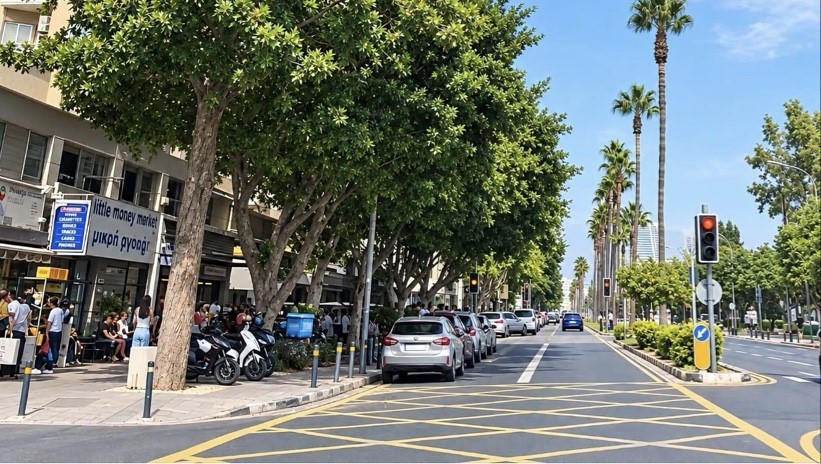
Photo credit: Tasos Ioannou / "Η ΛΕΜΕΣΟΣ ΜΑΣ" Facebook group
A Familiar Scene of Administrative Limbo
A recent photo shared on local social media captures a scene witnessed daily along Limassol's seafront avenue. Directly adjacent to a signalised pedestrian crossing, across the yellow box junction markings, and sitting on a lane designated for public transit, a row of private cars sits casually parked on the active roadway. Drivers routinely pull up outside kiosks and cafes, switch on their hazard lights, and leave their vehicles behind while moving traffic negotiates sudden lane shifts.
The deeper issue here is that this lane was intended as an active bus corridor under the city's Sustainable Urban Mobility Plan. Instead, it has remained formally inactive for months, caught between delayed political decisions, missing camera enforcement, and incomplete network connections. When authorities paint a bus lane on the asphalt but fail to activate and enforce it, the street space does not sit empty. It quickly degrades into an informal, free-for-all parking strip.
Compounding Hazards at Signalised Intersections
Under the Safe System framework, the approach to a signalised crossing requires clear visibility and predictable vehicle paths. Allowing vehicles to park along an inactive bus corridor right at an intersection generates clear, measurable hazards:
- Pedestrian sightline obstruction: Parked vehicles form a visual barrier along the curb, hiding pedestrians, especially children, elderly individuals, and wheelchair users, until the moment they step past the cars into an active lane.
- Forced merging friction: Through-traffic is forced to execute abrupt steering maneuvers directly inside the junction threshold, creating side-swipe and rear-end conflicts in an area where drivers should have uninterrupted forward focus.
- Transit corridor failure: The dormant bus lane is completely compromised before it even enters active service, reinforcing driver habits that treat transit infrastructure as parking overflow.
Yellow box markings exist specifically to keep junction throats clear. Allowing drivers to colonize this space because the bus lane is not yet operational undermines the entire function of the intersection.
The Failure of Half-Implemented Schemes
Leaving a bus lane dormant does more harm than simply delaying transit schedules. It normalizes violations. Once motorists develop the daily habit of parking in an unactivated transit corridor without facing penalties, activating that lane later faces fierce public pushback. Motorists begin to treat the space as an acquired right, making future enforcement far harder politically.
Relying on scarce municipal wardens to patrol these long corridors on foot has proven ineffective. European cities facing identical problems moved away from manual patrols long ago, adopting automated Intelligent Transport Systems (ITS) that operate continuously:
- Automated Scan-Cars (Paris, Amsterdam, Brussels): Municipal electric vehicles and mopeds fitted with 360-degree ANPR cameras drive along main corridors at standard traffic speeds. Using a calibrated dwell threshold, the software distinguishes between vehicles momentarily halted in queue and vehicles parked unlawfully in transit or junction zones, generating citations automatically.
- Junction video analytics (London - TfL): Transport for London utilizes fixed digital cameras covering yellow box junctions and bus corridors. Software tracks vehicle dwell times within virtual exclusion polygons, sending verified violations straight to processing without requiring officers on the curb.
- Smart micro-loading spaces (Barcelona, San Sebastián): Where businesses genuinely need quick delivery turnarounds, spaces are regulated with flush-mounted IoT ground sensors. Couriers receive a monitored five-to-ten-minute window via a mobile interface. Exceeding the window triggers an automatic fine, keeping the moving lanes completely free.
Physical Design and Curb Protection
Technology delivers results when paired with coherent street geometry:
- Physical transit lane separation: On multi-lane arterial corridors where the roadway cannot simply be narrowed down, installing physical separator curbs along the approach prevents private drivers from using the transit lane as an informal pull-in zone.
- Protective sidewalk barriers: Installing sturdy posts along the curb line approaching the intersection prevents vehicles from mounting footpaths and keeps pedestrian ramps completely unobstructed.
Drawing a bus lane on asphalt without opening it or enforcing it accomplishes nothing. It confuses road users and turns pedestrian crossings into hazard zones. The Municipality of Limassol and the Ministry of Transport need to resolve the legal and operational status of the seafront bus corridor, deploy automated enforcement cameras, and guarantee safe sightlines for everyone using the street.
About ITS Cyprus
ITS Cyprus brings together public authorities, research and industry to advance Intelligent Transport Systems in Cyprus, through initiatives such as Road to Zero Cyprus for road safety.
Learn more about ITS Cyprus →