Ride Outs and Street Flexing: Why Stunts on Electric Scooters Expose a Double Failure in Cyprus
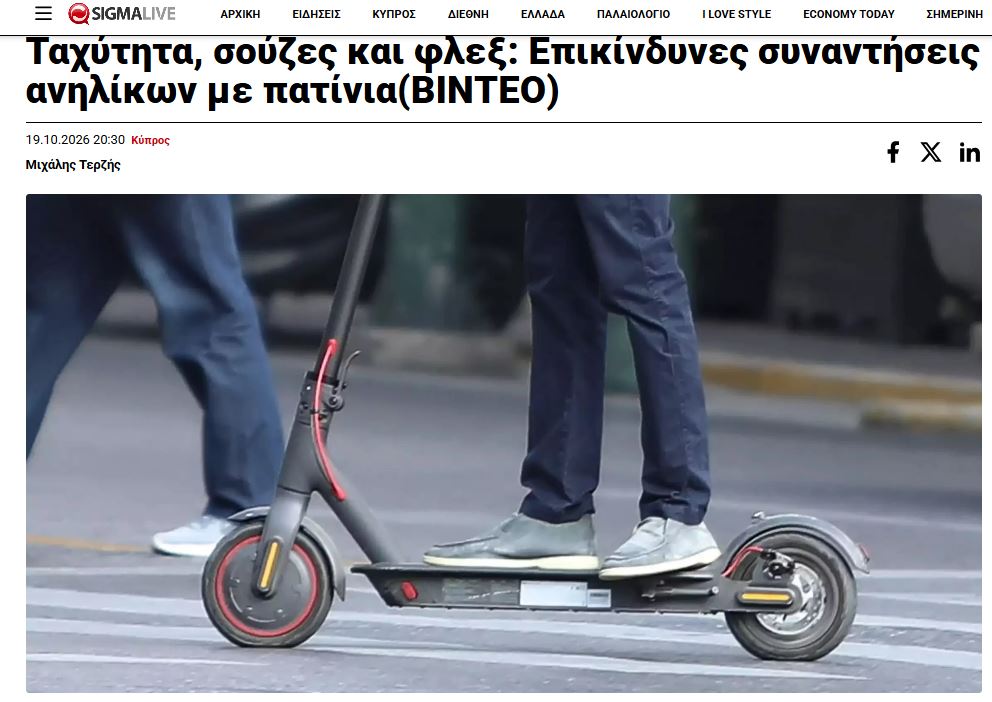
Stunts for Social Media Views
A recent report by Sigmalive documented a disturbing trend taking hold across Cypriot cities. Groups of minors organize online gatherings, known as ride outs, descending on multi-lane urban roads on electric scooters to perform high-speed stunts, weave through live traffic, and record videos for social media.
What appears on phone screens as adolescent showing off represents a severe road safety hazard in the physical world. Standing on lightweight devices with small wheels and minimal braking distances, these young riders expose themselves to catastrophic kinetic impacts against two-ton motor vehicles. The public reaction predictably calls for crackdowns and bans, but treating this as merely teenage misbehaviour overlooks the institutional failures that allow it to flourish.
The Fiction of the 20 km/h Regulatory Limit
Cyprus established a statutory framework for personal light electric vehicles, setting the minimum operational age at 14 years and capping maximum speed at 20 km/h. In reality, that legal framework exists largely on paper.
Retail outlets and online sellers routinely supply imported scooters capable of reaching speeds of 40 to 60 km/h straight out of the box, or easily unlocked through simple software tweaks. There is no systematic market surveillance at import points, no technical verification of speed limiters, and no registration requirement for private micro-mobility devices. Parents purchase high-powered machines for children who have received zero road safety education, unaware that an electric scooter traveling at 45 km/h carries kinetic forces comparable to a lightweight moped. Expecting traffic officers to chase individual teenagers across traffic lanes is an operational dead end. Enforcement must begin at the commercial point of entry and sale.
The Price of Missing Micro-Mobility Networks
Youth stunts and reckless grouping are partly fueled by a lack of dedicated space. Our cities have spent years debating Sustainable Urban Mobility Plans without constructing continuous, physically protected cycle networks.
When young riders take to the streets, they find themselves either illegally bouncing across broken sidewalks among pedestrians or forced onto wide, multi-lane arterials built exclusively for speeding cars. In the absence of safe, regulated micro-mobility corridors connecting residential areas with parks and sports facilities, the carriageway becomes an arena for spectacle. A Safe System approach recognizes that human beings, particularly adolescents, make poor risk judgments. Roads must be engineered to forgive errors rather than turn a lost balance into a fatal collision.
Intelligent Systems and Practical Interventions
Managing micro-mobility responsibly requires combining technical standards, technology, and design:
- Market surveillance and technical certification: The Ministry of Transport and Customs must enforce strict import checks, seizing scooters that lack factory-installed, tamper-proof speed limiters capped at statutory speeds.
- Parental accountability and education: Where minors operate vehicles in blatant breach of age and equipment laws, administrative penalties must engage guardians directly, paired with practical cycle training in schools.
- Protected physical corridors: Accelerating the construction of segregated cycle tracks along key urban links provides young riders with a designated space to travel safely, removing them from dangerous interactions with general traffic.
- Digital regulation for shared fleets: Commercial rental operators must continue utilizing mandatory GPS geofencing to throttle speeds and prevent unauthorized night use in high-risk zones.
Protecting Young Lives Before the Next Fatality
Dismissing these mass scooter gatherings as harmless youthful excitement ignores the reality of urban traffic. A small wheel hitting a pothole at 40 km/h leaves a rider with zero margin for recovery.
Authorities must stop waiting for a fatal collision to trigger another round of emergency meetings. Controlling non-compliant machinery at the border, educating families on real kinetic risks, and building safe physical lanes for active travel will protect both young riders and everyone sharing our streets.
--- Report reference: Based on reporting by [Sigmalive](https://www.sigmalive.com/news/local/1334001/takhytita-souzes-kai-fleks-oi-epikindines-sinantiseis-anilikon-me-patiniavid).
About ITS Cyprus
ITS Cyprus brings together public authorities, research and industry to advance Intelligent Transport Systems in Cyprus, through initiatives such as Road to Zero Cyprus for road safety.
Learn more about ITS Cyprus →