Trams in Nicosia and Limassol: The Essence of Modal Shift, Shelved Studies, and the Need for End-to-End Planning
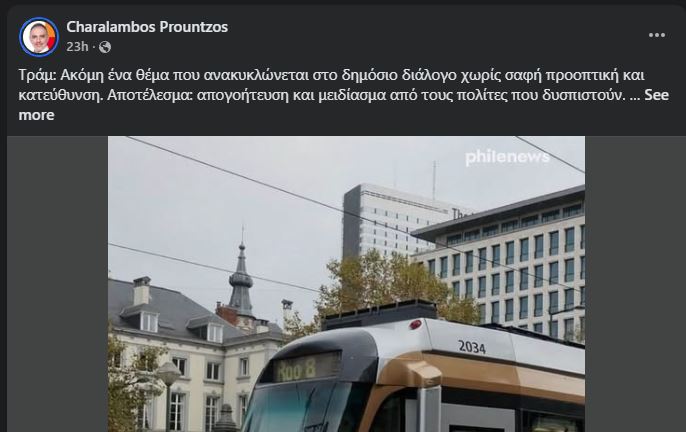
The recent public statement by the Mayor of Nicosia brought back to light a reality that Cyprus has long avoided facing. After seventeen years of the reformed public bus system and more than one billion euros in public spending, public transit modal share remains stubbornly stagnant at just 4 to 5%. Anyone opening a navigation app on their smartphone sees why immediately: taking the bus typically takes twice as long as driving a private car. Without dedicated, unhindered bus lanes, mass transit simply gets trapped in the exact same traffic gridlock as everyone else.
Genuine Modal Shift: Comparing Nicosia and Limassol
This directly connects to the broader discussion on light rail in Limassol. The core principle of transportation planning remains non-negotiable: what matters is genuine modal shift. The fundamental objective is moving commuters out of their cars and into public transport. It makes little sense to take people who are already on the bus and simply transfer them onto tracks.
In Limassol, proposing a coastal tram along the seafront clashes with practical reality. That corridor already hosts Cyprus's most successful bus route, Line 30. Laying tracks along Molos would merely replace an already functioning public transit service while leaving the real congestion untouched along north-south feeder corridors, suburban neighborhoods, and morning school runs. In Nicosia, by contrast, the proposal for a 20-kilometer light rail network budgeted at roughly 500 to 600 million euros targets primary commuting corridors where car dependency is absolute. There, light rail can serve as the structural backbone of urban mobility, with buses acting as feeders bringing passengers from surrounding neighborhoods directly to transit hubs.
Shelved Studies and the Need for End-to-End Delivery
The paradox in Cyprus is that we are not starting from scratch. A comprehensive feasibility study conducted by the Public Works Department and the Municipality of Nicosia has existed since 2015[cite: 7]. That study demonstrated that a 14.5-kilometer tram network across three lines was both technically feasible and economically viable[cite: 7]. Furthermore, following guidelines from the European Investment Bank (EIB) and the JASPERS mechanism, it outlined a phased rollout: first creating dedicated, high-capacity bus lanes along key avenues like Makariou, Limassol, and Strovolou to build demand, followed by full light rail implementation[cite: 7].
In Cyprus, we tend to commission expensive studies only to leave them locked in desk drawers. Instead of executing what was already planned and financed on paper, the public debate gets recycled from scratch every few years. What is sorely missing is an end-to-end approach: from updating data and securing European funding to procurement, civil works, system operations, and citizen handover, managed as a single, unbroken project pipeline.
Fragmented Governance and European Precedents
A key reason projects stall is administrative fragmentation. Today, institutional responsibilities are scattered. The Ministry of Transport awards bus contracts, Public Works oversees road geometries, the Town Planning Department drafts spatial plans, and local Municipalities remain passive observers, despite bearing the full brunt of resident frustration and local environmental degradation.
Other European cities resolved this administrative gridlock by establishing unified Metropolitan Transport Authorities. In France, cities comparable in scale to Nicosia and Limassol, such as Montpellier and Brest, formed joint inter-municipal transit bodies where local authorities collectively plan, finance, and deliver light rail and bus networks. In Spain, the transit consortium in Valencia brought national, regional, and municipal bodies around a single decision-making table, eliminating silos between road construction, traffic signals, and bus scheduling. When one authority holds end-to-end responsibility, transit projects are delivered on time and operate cohesively.
Time-Bound Co-Creation with the Community
To ensure any new transit network succeeds, we need structured co-creation. Planners must sit down with the actual users of the city: parents navigating streets with prams and young children, seniors, school and university students, persons with reduced mobility or disabilities, local residents, high-street merchants, and university researchers.
We need to understand firsthand what prevents a parent or an older resident from boarding a bus, how universal physical accessibility is guaranteed, and what would genuinely persuade a daily driver to leave their car at home. However, public consultation cannot become an excuse for endless delay. It must run under a strict, non-negotiable schedule of a few months, concluding with clear, actionable requirements.
Intelligent Transportation Systems (ITS) and Energy Resilience
Equally vital is the deployment of Intelligent Transportation Systems (ITS). Light rail and buses cannot succeed with outdated operating tools. They require Transit Signal Priority (TSP) to automatically secure green lights at busy junctions, reliable real-time passenger information displays and apps, and integrated traffic management platforms that give mass transit an undeniable speed advantage over private vehicles. Moreover, Nicosia's initiative to link the tram's energy needs to the local "Lefkothea" renewable energy community addresses operating expenditure head-on, leveraging affordable solar generation.
The Window of Opportunity
Time is running out. Current ten-year bus contracts expire in 2030, which means the specifications and network architectures for 2030–2040 are being framed right now. At the same time, the upcoming ETS 2 framework will substantially raise road fuel costs and emissions penalties, while the next major EU co-financing programming period opens in about a year.
We do not need another theoretical report filed away in a cabinet. We need unified governance, disciplined citizen co-creation under a tight timetable, and an end-to-end implementation roadmap that finally brings light rail and intelligent mobility into our streets.
Road to Zero Cyprus Initiative
This website is part of a broader national initiative by ITS Cyprus to implement Intelligent Transport Systems and advocate for Safe System policies to eliminate road traffic trauma across Cyprus.
Learn more about ITS Cyprus →